
Your Complete Travel Guide to the Nerve Centre of the Himalayas
By Jay Bamane | Senior Travel Correspondent, Trip Advisory | 4+ Years Travelling Across India
Last Updated: April 2026 | 10 min read
Table of Contents
| Quick Answer: Kaza is the administrative and travel headquarters of Spiti Valley, Himachal Pradesh, located at 3,800m above sea level — the only town with an ATM, fuel station, and connectivity before you venture into the remote high-altitude desert beyond. |
Deserves Your Attention in 2026
I have slept in a 200-year-old homestay in Langza. I have eaten thukpa at 4,400 metres while a monk walked past reciting prayers. I have watched the Milky Way from Chandratal with no phone signal and no Wi-Fi. And every single time, the journey began in Kaza.
Working as a travel correspondent at Trip Advisory and having crossed more Himalayan passes than I can count, I can tell you this with confidence: Kaza is not just a stopover. It is the gateway, the anchor, and the heartbeat of Spiti Valley travel. Get Kaza right, and the rest of Spiti falls beautifully into place.
This guide covers every key destination in and around Kaza — with honest pros and cons drawn from real experience, not press trips. Whether you are a first-timer who just booked flights to Chandigarh, or a seasoned hill traveller returning for your third Spiti circuit — this is the only guide you need.
Essential Facts About Valley
| Altitude: 3,800m (12,467 ft) | District: Lahaul and Spiti, Himachal Pradesh | Best Season: June–September | Nearest Airport: Bhuntar (Kullu), ~200 km | Connectivity: Limited Jio/BSNL in Kaza town only | Currency: Cash only beyond Kaza |
Before we dive into places to visit, here are three things that will save your trip:
- There is ONE ATM in Kaza (SBI). It runs dry on weekends. Withdraw before you arrive — ideally in Shimla or Manali.
- The only petrol pump in Spiti is in Kaza. Fill your tank completely before heading to Pin Valley, Langza, or Dhankar.
- Mobile data works patchily on Jio and BSNL inside Kaza town. Beyond town? Plan to go offline. Download offline maps on Maps.me or OsmAnd.
Top Places to Visit — With Honest Pros & Cons
Having personally visited every location listed below, I am giving you the unfiltered version — not the brochure version. Each place is rated on experience, accessibility, and crowd levels based on 2025–26 ground data.
1. Key Monastery (Ki Gompa) — The Icon of Spiti
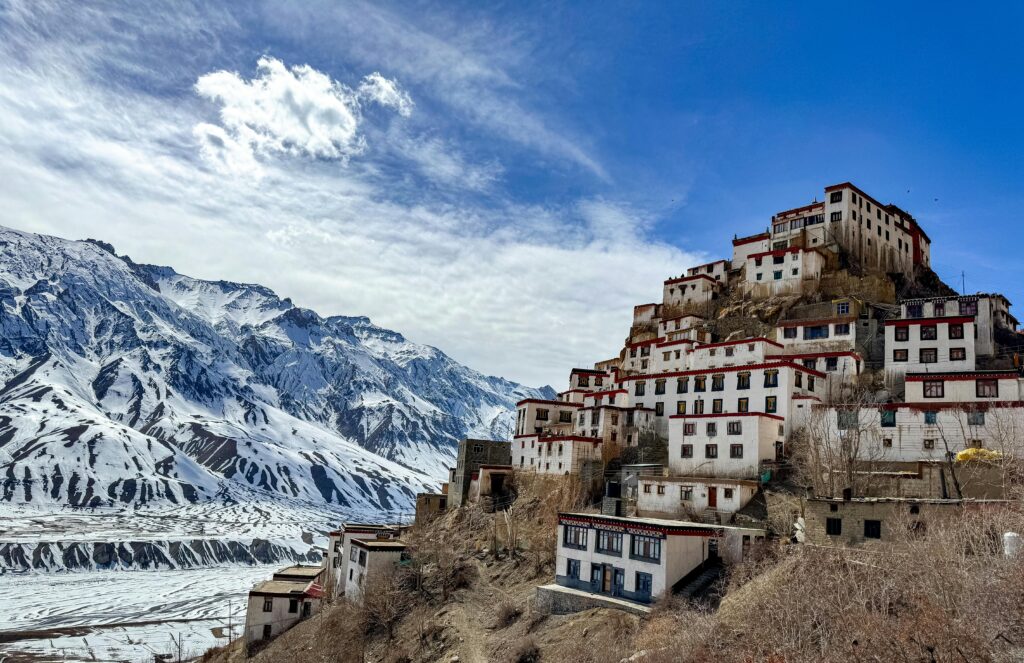
Perched at 4,166 metres on a rocky hilltop above the Spiti River, Key Monastery is Spiti’s most photographed landmark — and rightfully so. Founded in the 11th century, it houses over 300 monks and contains irreplaceable manuscripts, frescoes, and thangkas. The views from the rooftop at sunrise are the kind that make you forget your altitude headache.
Jay’s Tip: Visit on a weekday, arrive before 7 AM, and you will likely have the rooftop entirely to yourself. The morning prayer sounds drifting across the valley is something Instagram cannot replicate.
✅ Pros:
- Most impressive Himalayan monastery accessible by road — no trekking required
- Culturally rich — active monastery with daily rituals you can observe
- Stunning 360° views of the Spiti River valley from the rooftop
- Open to visitors year-round, even in limited winter access
- Photography permitted in most areas (ask monks for restricted zones)
❌ Cons:
- Gets extremely crowded July–August — early morning visits (6–7 AM) are essential
- Limited parking; vehicles queue on narrow roads during peak hours
- No food or water available inside — carry your own supplies
- Altitude (4,166m) can be rough if you arrived in Kaza the same day
- Some inner sanctums restrict photography — respect this boundary
2. Chandratal Lake — The Moon Lake of Spiti
Chandratal — literally ‘Moon Lake’ — is a crescent-shaped glacial lake sitting at 4,300 metres near Kunzum Pass. The water colour shifts between emerald, turquoise, and midnight blue depending on the hour and cloud cover. It is a 1.5 km circumambulation trail around the lake, and every step is a different postcard. One of the genuine wonders of the Indian Himalayas.
Jay’s Tip: Go in the second week of September. Crowds drop by 70%, the surrounding meadows turn golden, and you may have entire sections of the lakeshore to yourself.
✅ Pros:
- One of the most visually spectacular lakes in India — no filter needed
- Stargazing at the campsite is world-class on clear nights
- The walk around the lake is gentle and manageable for most fitness levels
- Accessible from both Manali and Kaza, making it ideal for circuit trips
- September visits offer solitude, golden grass, and perfect reflections
❌ Cons:
- July–August camping zone is heavily crowded — resembles a festival site
- Camping fees and regulated zones have been introduced; spontaneous camping is now restricted
- Road from Kaza (via Kunzum Pass) can be washed out after heavy rain
- No toilets or proper waste management near the lake — carry out your trash
- ATM and phone signal: absolutely zero. Cash and offline maps essential.
3. Dhankar Monastery and Dhankar Lake — Spiti’s Most Underrated Gem
Dhankar is what happens when a medieval fort, a Buddhist monastery, and a cliff decide to share the same real estate at 3,890 metres. The ancient mud-brick complex appears to melt into the rock face it sits on. A 45-minute uphill trek from the monastery takes you to the hidden Dhankar Lake — a still, blue mirror surrounded by barren peaks. Barely on any tourist itinerary. That is exactly why it should be on yours.
✅ Pros:
- Authentic — far fewer visitors than Key Monastery; more intimate experience
- The monastery architecture and cliff setting are genuinely jaw-dropping
- Dhankar Lake trek is short (3 km round trip) but delivers outsized reward
- The village around Dhankar offers real homestay experiences with Spitian families
- Excellent photography spot for landscape and architecture enthusiasts
❌ Cons:
- Road to Dhankar is rough — requires a 4WD or high-clearance vehicle
- The monastery is in a fragile structural condition — some sections are unsafe
- No accommodation directly at the monastery; stay in nearby Sichling or Kaza
- The lake trek is steep in the second half — not ideal with fresh altitude exposure
- Limited signage; a local guide is recommended for the first visit
4. Langza Village — The Fossil Village of Spiti
Langza sits at 4,400 metres and wears its altitude lightly. A giant white Buddha statue watches over terraced barley fields and fossil-rich soil — yes, you can literally pick up marine fossils from the ground here, evidence that this was once a Tethys Sea seabed. The silence in Langza is the kind that makes city noise feel like a distant absurdity.
✅ Pros:
- Marine fossils are freely visible and sometimes collectible along the paths
- The giant Buddha statue against the mountain backdrop is uniquely photogenic
- One of the highest villages accessible by road in Spiti — a real achievement
- Village homestays offer authentic Spitian food: butter tea, tsampa, thukpa
- Almost zero commercial tourism — raw, real, and unhurried
❌ Cons:
- Road from Kaza is rough, especially after rain — 17 km but takes 45+ minutes
- Altitude sickness risk is real at 4,400m — acclimatise in Kaza for 1–2 days first
- No shops, no ATMs, no restaurants — bring everything you need from Kaza
- Mobile signal: non-existent. Inform someone of your itinerary before heading up.
- Best visited as a day trip from Kaza; overnight stays require advance booking with homestays
5. Hikkim Village — Home to the World’s Highest Post Office
Hikkim holds a humble but extraordinary record: it houses the world’s highest operational post office at 4,440 metres. You can write a postcard here and it will actually reach its destination — mine took 18 days to reach Mumbai. Beyond the postal novelty, Hikkim is a tiny, charming village where yaks graze between stone houses and the horizon is nothing but peaks.
✅ Pros:
- Post a letter from the world’s highest post office — novelty and legitimacy combined
- Extremely off the tourist radar — you may be the only visitor on a given day
- Usually combined with Langza as a half-day village loop from Kaza (easy circuit)
- Friendly, unhurried locals who genuinely welcome visitors without commercial intent
- Outstanding stargazing at night — zero light pollution at this altitude
❌ Cons:
- The post office is sometimes closed on Sundays and government holidays — verify before you go
- Road condition is similar to Langza — rough and unpredictable post-rain
- Nothing to buy or eat here; treat it as a detour, not a full-day destination
- Altitude fatigue accumulates — if visiting Langza and Hikkim in one day, start early
- No guesthouses; overnight stays must be arranged with local families in advance
6. Pin Valley National Park — Snow Leopard Country
Pin Valley is Spiti’s wild card. A cold desert national park protecting one of India’s most viable snow leopard habitats, Pin Valley is where you go when you want to feel genuinely small. The Pin River runs through a barren, Mars-like landscape, and if you are lucky enough to spot a snow leopard or an ibex herd at dawn, you will understand why some travellers return to Spiti year after year.
✅ Pros:
- One of India’s best places for snow leopard sightings (December–February highest chances)
- Ibex, Himalayan wolves, and golden eagles are regularly spotted year-round
- The Mud village at the park entrance is one of Spiti’s most photogenic spots
- Relatively accessible from Kaza — 25 km on a manageable (if rough) road
- Pin Valley Homestay Network is well-organised; community tourism model works
❌ Cons:
- Snow leopard sightings are never guaranteed — nature does not follow itineraries
- Inner Line Permit may be required for deeper sections near the Tibet border — verify in advance
- Accommodation in Pin Valley is basic; manage expectations on comfort levels
- Road beyond Mud village requires a capable 4WD; no regular transport
- Winter visits (for snow leopard season) require serious gear and planning
7. Chicham Bridge — Asia’s Highest Village Suspension Bridge
Chicham Bridge is one of Spiti’s best-kept secrets that is slowly getting out. Connecting the cliff-hanging village of Chicham to the main Spiti road, this suspension bridge hangs over a dramatic gorge and delivers views that rival anything on the standard Spiti circuit. The village above the bridge is genuinely ancient — homestays here feel like stepping into a different century.
✅ Pros:
- Dramatic gorge views from the bridge — one of Spiti’s most photogenic spots
- The village of Chicham above is ancient, authentic, and barely touristy
- Short detour from the Kaza–Kibber road — easy to add to any day trip
- Bridge itself is structurally sound and a genuine engineering feat at this altitude
- Great opportunity to interact with locals who rarely see foreign visitors
❌ Cons:
- The road to Chicham village (above the bridge) is extremely narrow and steep
- No signage pointing to Chicham from the main road — easy to miss without GPS
- Not ideal for those with a fear of heights — the bridge crossing is exposed
- Zero amenities at the site — bring water and snacks from Kaza
- Mobile data: unavailable. Download offline maps before you leave Kaza.
Hidden Gems vs Overhyped Places in Kaza, Spiti Valley — The Honest Table
After years of travel writing and countless conversations with fellow travellers on the Spiti road, here is my personal assessment of which places truly deliver and which ones are coasting on Instagram reputation.
| Place | Status | Reason |
| Hikkim Village | Hidden Gem | World’s highest post office at 4,400m — barely visited. Unreal sky views, locals share chai without a tourist lens. |
| Langza Village | Hidden Gem | A massive Buddha statue overlooks a fossil-strewn valley. You can find marine fossils right off the path. No tour groups here. |
| Dhankar Monastery + Lake | Hidden Gem | Crumbling fort-monastery on a cliff edge. The lake trek is brutal but empties your mind completely. Barely 50 visitors/day. |
| Chicham Bridge | Hidden Gem | Asia’s highest bridge connecting two cliff-hanging villages. Photogenic beyond belief — yet somehow still off most itineraries. |
| Pin Valley National Park | Hidden Gem | Snow leopard territory. Bone-dry landscapes, ibex sightings at dawn. You will likely have entire trails to yourself. |
| Key Monastery | Slightly Overhyped | Beautiful, yes. But Instagram traffic has turned morning hours into a photo queue. Go at 6 AM or skip peak months. |
| Chandratal Lake | Overhyped in Peak Season | Genuinely stunning. But July–August camping zones look like a music festival. Go in September for the real experience. |
| Kaza Market | Mildly Overhyped | Tourists expect a bazaar; it’s a quiet town square with a few cafes. Great for supplies but don’t make it a destination. |
| Trip Advisory Note: ‘Overhyped’ does not mean ‘bad.’ It means the experience on the ground often falls short of the expectation set by social media. Visit them — but recalibrate your expectations and time your visit wisely. |
Practical Travel Tips for Kaza, Spiti Valley
Getting There
- Route 1: Delhi → Shimla → Rampur → Reckong Peo → Nako → Tabo → Kaza (via NH5 / Hindustan-Tibet Highway). Open from April. Gradual altitude gain — better for acclimatisation. ~700 km from Delhi.
- Route 2: Delhi → Manali → Rohtang Pass → Kunzum Pass → Kaza. Open June to October only. Faster but more dramatic altitude gain. ~570 km from Delhi.
- Nearest airport: Bhuntar (Kullu-Manali Airport). Fly in, rest overnight in Manali, then road trip to Kaza.
Acclimatisation Schedule
- Day 1: Arrive Kaza. Rest. No strenuous activity. Hydrate constantly.
- Day 2: Short walk around Kaza town. Visit local monastery. Observe how your body feels.
- Day 3 onwards: Begin higher altitude excursions (Langza, Hikkim, Chandratal).
Budget Snapshot (2026)
- Budget guesthouse/homestay in Kaza: ₹500–₹800/night
- Mid-range hotel in Kaza: ₹1,200–₹2,500/night
- Meals: ₹100–₹250 per meal at local dhabas and cafes
- Bike rental (Royal Enfield): ₹1,200–₹1,800/day
- Taxi (Innova/Bolero) for full-day local sightseeing: ₹2,500–₹4,000
Frequently Asked Questions — Kaza, Spiti Valley
Q1. Is Kaza, Spiti Valley safe for solo female travellers?
Absolutely — and I say this from having met dozens of solo women travellers on the road to Kaza. Locals are warm, guesthouses are secure, and the traveller community is tight-knit. Standard precautions apply: share your itinerary, carry offline maps, and avoid unmarked trails after dark. Spiti is genuinely one of India’s safest high-altitude destinations for solo women.
Q2. What is the best time to visit Kaza, Spiti Valley?
The sweet spot is mid-June to mid-September. The Manali–Kaza road opens by late May and closes by late October due to snowfall. July and August see the most footfall — ideal for weather but not for solitude. If you want crowd-free, golden-lit Spiti, aim for the second week of September: passes are still open, skies are crystal clear, and tourist numbers drop by 60%.
Q3. Are there ATMs in Kaza? How much cash should I carry?
Kaza has one functioning ATM (State Bank of India), but it runs dry on weekends and during peak season. Beyond Kaza — in villages like Hikkim, Langza, or Dhankar — there are zero ATMs. Always withdraw before heading deeper into Spiti. I recommend carrying a minimum of ₹5,000–₹8,000 in small denominations, plus your total trip budget in cash. Card payments are rare even in Kaza itself.
Q4. How do I get to Kaza from Delhi?
There are two main routes: (1) Delhi → Shimla → Kinnaur → Kaza via the Hindustan-Tibet Highway — longer at 700+ km but more gradual for acclimatisation, accessible from April. (2) Delhi → Manali → Rohtang Pass → Kunzum Pass → Kaza — the classic road trip route, open June to October only. No direct flights or trains. Flying to Chandigarh and driving reduces travel time but you still have 10–12 hours of mountain road from there.
Q5. Do I need permits to visit Spiti Valley / Kaza?
Indian nationals do not need an Inner Line Permit for Kaza and most of Spiti Valley. However, if you plan to visit Pin Valley (restricted zones), you may need prior permission. Foreign nationals need to register at checkpoints — carry multiple passport copies. Note that areas close to the Tibet border (like Shipki La) require special permits for all travellers. Always verify the latest permit requirements before travel as these rules change seasonally.
Final Word from Jay Bamane
Every traveller I have met on the road to Kaza carries the same expression: a mix of exhaustion, wonder, and quiet gratitude. This is what Spiti does to you. It strips away the noise.
Kaza is not glamorous. There is no five-star hotel, no mall, no 5G signal. But it has crumbling monasteries that have outlasted empires, families who will feed you butter tea before you have finished removing your shoes, and skies so full of stars that you will question every life choice that kept you in a city.
Book your trip in 2026. Come before the next wave of discovery changes it permanently.
| This article is written by Jay Bamane, Senior Travel Correspondent at Trip Advisory. Jay has spent 4+ years travelling across India with a focus on high-altitude Himalayan destinations, offbeat Northeast circuits, and sustainable travel in rural India. |